
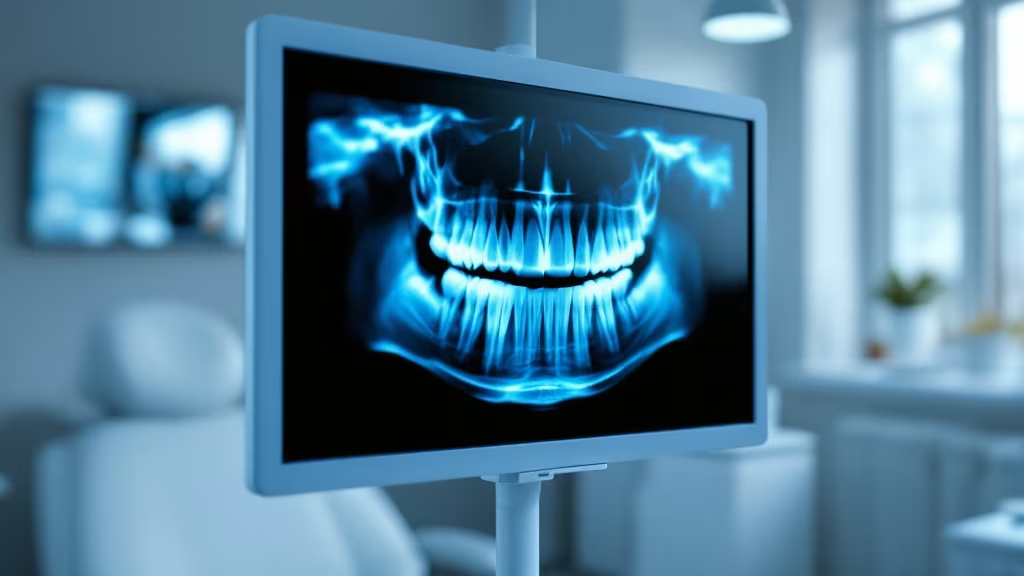
If your wisdom teeth came in fully, sit in a healthy bite, and stay clean, nothing bad automatically happens when you keep them. If they are trapped or only partway through the gum, problems tend to build quietly over the years. At Sola Dental Spa in Staten Island, Dr. Daniel Nejat, DMD, our board-certified periodontist, sees both endings regularly: patients in their sixties with healthy wisdom teeth they have had all their lives, and patients whose deferred decision turned into an infection on a holiday weekend. The difference is rarely luck. It is position, cleanability, and whether anyone was watching. Wisdom tooth evaluations and extractions are part of the care we provide at Sola Dental Spa.
Keeping wisdom teeth is a legitimate choice when they erupted fully and can be cleaned, but they must be monitored, because the risk picture changes with age. Impacted or partially erupted teeth left alone can develop decay, gum infection, damage to the neighboring molar, or in some cases a cyst.
“Not removing your wisdom teeth is a decision, and it needs the same follow through as any other decision. I am comfortable monitoring a well positioned tooth for decades. What concerns me is the tooth nobody has imaged in ten years, because the problems that build around a trapped tooth are painless right up until they are not.”
Dr. Daniel Nejat, DMD, Board-Certified Periodontist, Sola Dental Spa
A patient from Westerleigh in his mid thirties had skipped dental visits for most of a decade and figured his wisdom teeth were fine because they never hurt. One lower tooth had only partially erupted, and the gum flap over it had been trapping food the whole time. By the time swelling sent him to us, the tooth beside it had decay on its back surface. We treated the infection, removed the wisdom tooth, and restored the neighbor, all fixable, but two of those three visits were avoidable with monitoring.
Can you keep your wisdom teeth without problems?
Yes. Fully erupted, functional, cleanable wisdom teeth can last a lifetime. The condition is real monitoring: regular checkups, cleanings, and periodic X-rays.
The American Dental Association notes that wisdom teeth that are not removed should continue to be monitored, because the potential for problems still exists and rises as people age. That is not a scare line, it is a maintenance schedule. Third molars sit in the hardest corner of the mouth to brush and floss, so the margin for sloppy hygiene is thinner than it is for your front teeth. Patients who keep up with visits and flossing routinely keep these teeth for good. If yours are still erupting and you are deciding what is normal, start with our guide on how to know if your wisdom teeth are coming in.
What can go wrong when a poorly positioned tooth stays?
Cavities in a tooth you cannot clean, gum disease around it, decay or bone loss on the neighboring molar, and occasionally a cyst forming around an impacted tooth.
The American Association of Oral and Maxillofacial Surgeons explains that an impacted wisdom tooth can damage neighboring teeth, collect bacteria that lead to gum disease, and in some cases develop a cyst or tumor around it that harms adjacent teeth and the surrounding bone. The pattern that makes these risks tricky is their silence. A cavity on the back of your second molar or a slowly growing cyst produces no symptoms for a long time, which is exactly why the X-ray, not the absence of pain, is the honest measure of how a kept wisdom tooth is doing.
Why is a partially erupted tooth the riskiest kind?
Because the flap of gum over a half erupted tooth traps food and bacteria in a space no toothbrush reaches, which can lead to a painful recurring infection called pericoronitis.
A tooth fully under bone is at least sealed away, and a fully erupted tooth can be cleaned. The tooth stuck halfway gets the worst of both worlds: an open door for bacteria and no way to clean house. Recurring swelling, a bad taste, and jaw stiffness on one side are its calling cards. One episode can often be settled with cleaning under the flap and salt water rinses, but when the infections repeat, removal is usually the recommendation, because the anatomy that caused the first episode has not changed.
Does the risk change as you get older?
Yes. Roots lengthen, bone gets denser, and healing slows, so a removal that was simple at 20 is usually more involved at 50. Health conditions and medications add complexity too.
This is the strongest argument for deciding on purpose rather than by default. If a tooth is likely to cause trouble eventually, removing it younger usually means an easier surgery and a quicker recovery. If it is genuinely healthy, keep it and watch it. What ages poorly is the unexamined middle ground. Our guide to wisdom teeth removal for older adults covers what changes when the decision arrives later in life.
| Your situation | What tends to happen if ignored | The sensible move |
|---|---|---|
| Fully erupted, clean, healthy | Often nothing, for decades | Keep and monitor at regular visits |
| Partially erupted | Food trapping, recurring gum infection | Evaluate promptly, often removal |
| Fully impacted, no symptoms | Usually quiet, occasionally cysts or pressure on the neighbor | Periodic imaging to catch changes early |
| Tilted into the second molar | Decay or bone loss on the neighbor | Removal before the neighbor pays for it |
Frequently asked questions
My wisdom teeth never hurt. Do I still need them checked?
Yes, and this is the most common misunderstanding we hear from Staten Island patients. Decay behind a second molar and cysts around impacted teeth are usually painless until they are advanced. A quick look and periodic imaging is cheap insurance.
Will my wisdom teeth push my other teeth and make them crooked?
The evidence on wisdom teeth causing front tooth crowding is mixed, and the ADA describes crowding as something some believe can occur when there is no room. The clearer, better documented risk is damage to the second molar directly in front of a tilted tooth.
How often should kept wisdom teeth be X-rayed?
There is no single universal interval. Dr. Nejat sets it by position and history, typically every few years for a quiet, fully impacted tooth and sooner when anything about the gum or the neighbor changes.
Can a wisdom tooth problem really become an emergency?
It can, in the specific sense that a brewing infection tends to announce itself at the worst time. Most of the urgent wisdom tooth visits we see were preventable weeks earlier, when the symptoms were mild and easy to dismiss.
If I decide to keep mine, what do I actually have to do?
Floss around them daily, keep your regular cleanings, and agree on an imaging schedule. That is the whole contract. Keep it, and keeping your wisdom teeth is a perfectly sound plan for many people.