
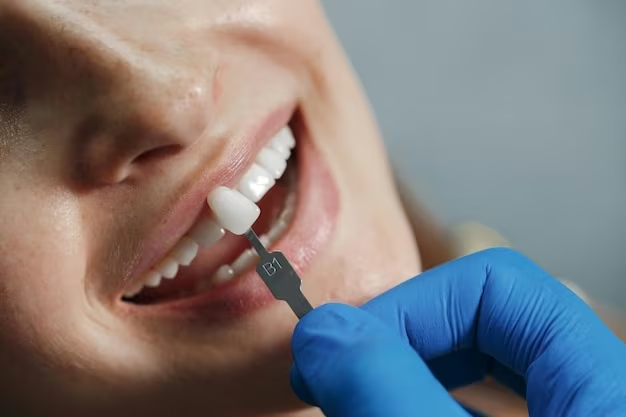
Dental veneers are thin, custom-made shells, usually porcelain, that bond to the front surfaces of teeth to change their color, shape, length, or spacing while the natural tooth stays alive underneath. At Sola Dental Spa in Staten Island, cosmetic dentist Dr. Anne Gershkowitz, DDS designs and hand-finishes porcelain veneers through a staged process that runs from first photographs to final polish. The complete treatment picture is on our dental veneers page.
A veneer works like a precision facing: a conservative layer of enamel is shaped, an impression captures the tooth exactly, a laboratory crafts a thin porcelain shell, and dental cement bonds it permanently to the front of the tooth. The bond is what makes a fragile-looking shell perform like part of the tooth.
“Patients are always surprised by how thin a veneer is before bonding, about the thickness of a contact lens at the edges. Alone, it is delicate. Bonded to enamel, it becomes part of a structural system that handles years of biting and speaking. The chemistry of that bond is the whole trick, and it is a very good trick.”
Dr. Anne Gershkowitz, DDS, Founder, Sola Dental Spa
A software developer from Grasmere spent months researching veneers online and arrived with a folder of questions, mostly about whether his teeth would be ground down under the porcelain. We put a finished veneer in his palm, showed him a half-millimeter preparation on a model, and walked the folder together. He chose six veneers for his upper front teeth, and later told us the model demonstration answered more than the folder ever did.
What exactly is a veneer made of?
Most veneers are layered dental porcelain, a fired ceramic chosen because it handles light like enamel and resists stains. Composite resin veneers exist as a shorter-lived, lower-cost alternative.
Porcelain earns its place because enamel is translucent, and flat, opaque materials read as false the moment light hits them. A laboratory ceramist builds each veneer in layers, denser toward the gumline and more translucent at the edge, mimicking how a natural tooth transmits light. The American Dental Association describes veneers as a standard treatment for chipped, stained, misshapen, or slightly crooked front teeth, and porcelain is the material that standard is built on.
How does the process work, step by step?
Consultation and design, conservative enamel preparation under local anesthetic, temporaries while the laboratory works, then a bonding appointment where each veneer is fitted, adjusted, and permanently cemented.
The staged process exists to remove surprises. Design comes first: photographs, impressions, and a conversation about what you want changed. Preparation shapes roughly half a millimeter of enamel so the finished tooth is not bulky. Temporaries act as a rehearsal you wear and evaluate in daily life. Bonding day is the quiet finale, cement cured by light, edges polished, bite checked. Cost questions usually arrive around this point in the research, and we answer them plainly in how much do dental veneers cost.
Why do bonded veneers hold up so well?
Because enamel bonding is one of the most reliable adhesions in dentistry. The cement grips microscopic texture in both the enamel and the porcelain, creating a unified structure that distributes biting force across the whole tooth.
This is why preserving enamel during preparation matters so much: the bond to enamel is the veneer’s foundation. Once bonded, veneers handle normal eating, speaking, and brushing for a decade or more. They are not invincible, ice-chewing and unmanaged grinding remain their natural enemies, but maintenance is ordinary hygiene, covered in caring for your veneers.
| Stage | What happens | Time in the chair |
|---|---|---|
| Consultation | Exam, photos, design conversation | One relaxed visit |
| Preparation | Enamel shaped under anesthetic, impressions taken | One appointment |
| Laboratory phase | Ceramist layers each veneer; you wear temporaries | No chair time |
| Bonding | Try-in, adjustment, permanent cementation | One appointment |
| Follow-up | Bite check and polish | Brief visit |
Frequently asked questions
Do veneers damage the natural tooth?
No. The preparation removes a conservative enamel layer, about half a millimeter, and the tooth remains alive and healthy under the bonded porcelain.
How long do veneers take from start to finish?
The staged process typically spans a few weeks, driven mostly by the laboratory phase where each veneer is custom layered. Your schedule sets the pace as much as ours does.
Can veneers go on just my top teeth?
Yes, and that is the most common configuration, since upper teeth dominate the visible smile. Lower teeth are often whitened to match instead.
Are veneers reversible?
Not in the strict sense, because prepared enamel does not grow back. Veneers can be replaced when they age, but the commitment to some form of facing is permanent, which is why we plan carefully.
Whom should I trust to place them?
A dentist who shows real cases, explains candidacy honestly, and finishes the work personally. In Staten Island, that is exactly the practice Dr. Anne Gershkowitz has built at Sola Dental Spa.