
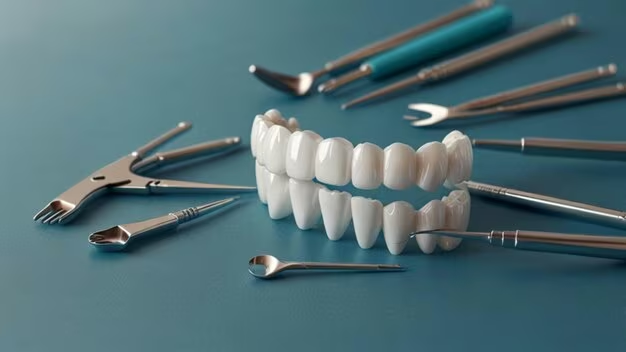
Porcelain veneers can mask minor misalignment, small gaps, and uneven tooth shapes, but they do not move teeth. Because a veneer only covers the visible front surface, it creates the appearance of a straighter smile without changing where the tooth actually sits. At Sola Dental Spa in Staten Island, we screen every case carefully so veneers are only recommended when the underlying alignment can genuinely support them.
What can porcelain veneers fix, and what can't they fix?
Veneers are thin, custom-made shells bonded to the front of the teeth. Because they sit on top of the tooth rather than repositioning it, the result is purely visual. For mild cosmetic concerns, that visual change is often enough to feel like a full smile transformation. For crowding, crossbite, overbite, underbite, or significantly rotated teeth, veneers alone will not deliver a stable, healthy result.
This is one of the most common questions we hear from patients who want a straighter-looking smile without committing to months of orthodontic treatment. The honest answer depends entirely on what "crooked" means in your specific mouth. A tooth that sits slightly forward or is a little narrower than its neighbor is a very different situation from a bite where the upper and lower jaws do not meet correctly. The first is a strong candidate for veneers. The second needs orthodontic evaluation before any cosmetic work is considered, since covering a structural problem with porcelain does not fix the underlying mechanics.
| Issue | Can veneers help? |
|---|---|
| Minor crooked or uneven teeth | Yes, masks imperfections for a straighter look |
| Small gaps between teeth | Yes, closes gaps and improves uniformity |
| Worn or chipped edges | Yes, restores shape and length |
| Discoloration or stains | Yes, provides a uniform, natural-looking shade |
| Moderate to severe crowding | No, orthodontic treatment is recommended |
| Bite issues like overbite or crossbite | No, orthodontic treatment is recommended |
For a closer look at how veneers stack up against orthodontic care, see our article on veneers vs. braces for crooked teeth.
How crooked is too crooked for veneers?
Veneers work well for cosmetic-level misalignment that does not affect chewing or bite function. Once teeth are crowded enough to need significant reshaping, or the bite itself is off, orthodontic treatment is the safer and longer-lasting option. If teeth are too rotated or crowded, fitting a veneer would require removing an amount of healthy enamel that compromises the tooth's long-term health, which is exactly why candidacy screening happens before any cosmetic treatment is planned.
Veneers vs. orthodontic treatment: which is right for you?
| Treatment | Best suited for | What it changes |
|---|---|---|
| Porcelain veneers | Minor cosmetic concerns | Appearance only, does not move teeth |
| Invisalign | Mild to moderate alignment issues | Physically repositions teeth |
| Traditional braces | Moderate to severe alignment and bite issues | Physically repositions teeth and jaw relationship |
Some patients combine the two: a course of Invisalign first to bring teeth into a better position, followed by a small number of veneers to refine shape, length, and color. This approach often allows for a more conservative enamel reduction and a better final result than veneers alone.
"Invisalign is excellent for the right case and frustrating for the wrong one. We screen carefully and tell patients honestly when traditional braces would deliver a better result, even if it is not what they hoped to hear."
Dr. Anne Gershkowitz, DDS, Founder, Sola Dental Spa
How long do veneers last, and what should you expect?
With good oral hygiene and routine dental visits, porcelain veneers typically last many years before replacement is needed. Compared with dental crowns, placement is less invasive because only a thin layer of the front surface is reshaped. Care is straightforward: brush twice daily with a non-abrasive toothpaste, floss daily, keep up with checkups every six months, and wear a nightguard if you grind or clench.
Frequently asked questions
Can veneers replace braces?
No. Veneers cover the visible front surface of teeth to create the appearance of a straighter smile, while braces and Invisalign physically move the teeth. For mild cosmetic crookedness, veneers can be a faster path; for true alignment problems, orthodontic treatment is the right choice.
Can veneers close gaps between teeth?
Yes. Closing small to moderate gaps is one of the most predictable uses of porcelain veneers. By making the veneers slightly wider than the underlying tooth, a dentist can close gaps while keeping proportions natural-looking.
Will veneers fix an underbite or overbite?
No. Bite problems come from how the upper and lower jaws meet, and veneers do not change jaw position. Orthodontic treatment, and in some cases jaw surgery, is what corrects a true overbite, underbite, or crossbite.
Can I get veneers if I had braces as a kid?
Often, yes. Patients whose teeth have shifted slightly since childhood orthodontics are common candidates for a small number of veneers to refine shape, length, and color. A current dental exam confirms that your bite is stable and the underlying teeth are healthy first.
Is veneer treatment faster than orthodontic treatment?
Generally, yes, since veneers do not require the months of gradual movement that Invisalign or braces do. The trade-off is that veneers are a cosmetic cover, not a structural correction, so the two treatments solve different problems.
Sources: ADA MouthHealthyADA MouthHealthy